
Leak Investigations at a Commercial Building in Greater Manchester
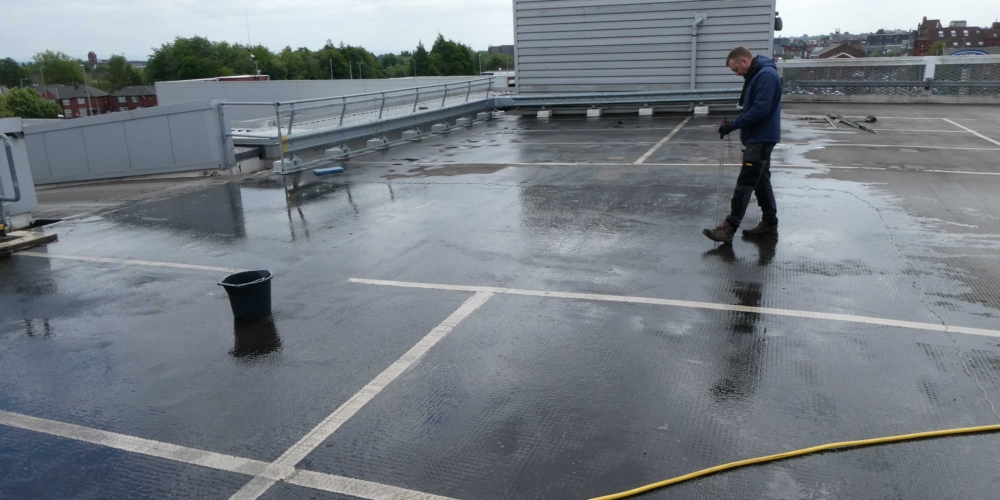
We were appointed by our client to undertake leak investigations at a commercial building in Greater Manchester. They had been experiencing persistent water ingress at ten internal locations beneath its rooftop car park. The building was comprised of a concrete frame, asphalt waterproofing, and metal cladding. With disruption growing and the source of the leaks unknown, the client approached us to deliver a fast, accurate, and minimally intrusive diagnostic investigation.
Scope of Works
- Quickly identify the cause of all ten leaks
- Assess the condition of the asphalt waterproofing system
- Determine whether issues stemmed from the roof, the façade, or critical building interfaces
- Provide clear, actionable solutions backed by reliable test data
Our Approach
To deliver a definitive answer, we deployed a suite of specialist leak-diagnostic techniques.
- Electronic Leak Detection (ELD)
Electronic leak detection was used across the rooftop asphalt surface to locate any breaches therein.
Outcome: Numerous breaches were pinpointed, particularly around upstands and VRS plinths. Many were of a significant nature.
- Flood Testing with Fluorescent Dye
Targeted flood testing to breaches in the asphalt waterproofing, incorporating a fluorescent marker, confirmed these to be a source of the leaks.
Outcome: Fluorescent dye appeared internally in key areas, providing unmistakable proof of direct water pathways through the asphalt waterproofing at numerous locations.
- Simulated Rainfall Testing
We performed controlled hose testing on pipe & cable penetrations, parapet capping and cladding.
Outcome: Two leak points were successfully replicated, highlighting issues with the detailing of the capping and damp proof membranes beneath.
- Internal Moisture Profiling
Moisture mapping inside the building allowed us to trace moisture pathways and understand how water was travelling through the structure. This technique is particularly useful when leaks manifest as damp patches rather than visible drips.
Outcome: A recordable increase in moisture confirmed the source of a further two of the leaks when combined with external water tests.
Findings
Our multi-layered approach delivered a complete picture:
- Significant breaches in the asphalt waterproofing system were the primary cause of ingress at most locations.
- Cladding interfaces were confirmed as additional sources of two leaks requiring additional inspections into damp proof membrane beneath.
- Localised flood testing also confirmed the performance of some items to be satisfactory, such as expansion joints, which require no further action.
Conclusion
We delivered a consolidated set of findings and a prioritised remediation plan that allowed the client to take immediate action:
- Repair defects in asphalt waterproofing
- Address damp proof membrane issues beneath cladding and seal cladding joints
- Re-test repairs to confirm integrity
- Regularly maintain roof to ensure it meets or exceeds it expected serviceable life
Our investigation provided the certainty the client needed—eliminating guesswork, reducing risk, and ensuring that future repair works would be both targeted and cost-effective.
Our Accreditations


